'%20fill='%23000000'%20stroke='none'%3e%3cpath%20d='M%201784.53%205631.9%20C%201775.53%205618.9%201692.53%205479.9%201598.53%205322.9%20C%201395.53%204983.9%201355.53%204919.9%201342.53%204915.9%20C%201332.53%204912.9%201315.53%204938.9%201090.53%205311.9%20C%201023.53%205423.9%20960.53%205523.9%20951.53%205534.9%20C%20936.53%205549.9%20918.53%205552.9%20816.53%205552.9%20C%20751.53%205552.9%20696.53%205548.9%20692.53%205542.9%20C%20689.53%205537.9%20721.53%205475.9%20763.53%205405.9%20C%20806.53%205335.9%20855.53%205252.9%20872.53%205222.9%20C%20889.53%205192.9%20941.53%205106.9%20987.53%205032.9%20C%201032.53%204958.9%201161.53%204746.9%201272.53%204562.9%20C%201383.53%204378.9%201522.53%204147.9%201581.53%204050.9%20L%201689.53%203872.9%20L%201823.53%203872.9%20C%201897.53%203872.9%201957.53%203874.9%201957.53%203876.9%20C%201957.53%203879.9%201887.53%203997.9%201800.53%204139.9%20C%201513.53%204612.9%201487.53%204657.9%201487.53%204674.9%20C%201487.53%204697.9%201788.53%205192.9%201802.53%205192.9%20C%201807.53%205192.9%201830.53%205162.9%201852.53%205125.9%20C%201874.53%205088.9%201902.53%205042.9%201913.53%205023.9%20C%201925.53%205003.9%201993.53%204890.9%202065.53%204772.9%20C%202395.53%204228.9%202458.53%204121.9%202452.53%204112.9%20C%202448.53%204106.9%202382.53%204102.9%202287.53%204102.9%20C%202200.53%204102.9%202126.53%204098.9%202123.53%204094.9%20C%202120.53%204089.9%202147.53%204038.9%202183.53%203979.9%20L%202249.53%203872.9%20L%202563.53%203872.9%20C%202736.53%203872.9%202877.53%203875.9%202877.53%203878.9%20C%202877.53%203882.9%202812.53%203991.9%202734.53%204121.9%20C%202537.53%204445.9%202057.53%205239.9%201929.53%205452.9%20C%201801.53%205664.9%201804.53%205662.9%201784.53%205631.9%20Z'%20style='fill:%20rgb(215,%2032,%2038);'/%3e%3cpath%20d='M%202191.53%205539.9%20C%202187.53%205527.9%202443.53%205099.9%203052.53%204100.9%20L%203191.53%203872.9%20L%203324.53%203872.9%20C%203397.53%203872.9%203457.53%203874.9%203457.53%203876.9%20C%203457.53%203879.9%203366.53%204031.9%203255.53%204214.9%20C%203144.53%204397.9%202964.53%204696.9%202854.53%204877.9%20C%202744.53%205059.9%202607.53%205285.9%202550.53%205380.9%20L%202445.53%205552.9%20L%202321.53%205552.9%20C%202226.53%205552.9%202195.53%205549.9%202191.53%205539.9%20Z'%20style='fill:%20rgb(215,%2032,%2038);'/%3e%3cpath%20d='M%201029.53%204386.9%20C%201014.53%204360.9%20993.53%204325.9%20982.53%204308.9%20C%20970.53%204291.9%20938.53%204237.9%20909.53%204187.9%20C%20880.53%204138.9%20829.53%204053.9%20797.53%203999.9%20C%20764.53%203944.9%20737.53%203894.9%20737.53%203886.9%20C%20737.53%203874.9%20759.53%203872.9%20864.53%203874.9%20L%20991.53%203877.9%20L%201099.53%204049.9%20L%201207.53%204220.9%20L%201144.53%204326.9%20C%201110.53%204384.9%201076.53%204432.9%201069.53%204432.9%20C%201062.53%204432.9%201044.53%204411.9%201029.53%204386.9%20Z'%20style='fill:%20rgb(215,%2032,%2038);'/%3e%3c/g%3e%3c/svg%3e)

Building Proprietary Value with Custom Machine Learning Model Development
Relying on third-party APIs for your core product isn't a strategy; it's a lease on someone else’s intellectual property. While 88% of organizations have adopted AI in at least one business function as of 2026, most remain stuck in a cycle of high failure rates and mounting technical debt. You've likely felt the friction of junior-led prototypes that never quite reach production or the vulnerability of building your business on a foundation you don't own.
Real competitive advantage comes from custom machine learning model development that turns your unique data into a proprietary asset. This isn't about chasing buzzwords; it's about systematic precision and predictable engineering velocity. You need to know exactly when to fine-tune existing models and when the mission requires building from scratch to ensure long-term stability.
This guide provides a senior-led roadmap to help you navigate these technical decisions. We'll explore how to move from raw data to a production-grade model that creates lasting value, ensuring your AI initiatives are handled with the professional authority and logic they deserve.
Key Takeaways
- Learn why senior architects prioritize data pipeline stability and engineering over model training to ensure predictable production performance.
- Identify the strategic thresholds where custom machine learning model development becomes more cost-effective and secure than relying on third-party APIs.
- Understand the role of a paid scoping session in validating technical feasibility and data quality before committing to full-scale development.
- Discover how to bridge the "Junior AI Gap" by utilizing senior-led engineering to prevent technical debt and expensive rescue projects.
- Compare the long-term proprietary value of bespoke algorithmic frameworks against the risks of model drift and service outages in external platforms.
What is Custom Machine Learning Model Development?
Custom machine learning model development is the architectural process of designing, training, and deploying a bespoke algorithmic framework tailored to your specific datasets. It moves beyond generic pattern recognition to provide domain-specific intelligence that off-the-shelf tools cannot replicate. Before diving into bespoke solutions, it helps to ground the discussion in the fundamentals of What is Machine Learning? as a broader discipline. This engineering process rests on three essential pillars: robust data engineering, precise model architecture, and scalable production deployment. Data engineering builds the pipelines that clean and structure raw information; architecture defines the mathematical framework; and deployment ensures the system performs under real-world loads. Ultimately, custom ML functions as a proprietary asset that solves unique business logic through specialized intelligence.
Proprietary Intelligence vs. Commodity AI
Off-the-shelf models create a parity trap. When every competitor uses the same third-party APIs, your product's intelligence becomes a commodity. Custom models build a defensive moat by utilizing unique data training and specialized weighting that competitors can't access. It's the difference between renting a tool and owning the factory. Owning your AI means you control the performance, the costs, and the intellectual property. While API costs might seem low initially, they scale poorly as volume increases. High-volume applications often find that hosting a custom model is more economical than paying for every token sent to an external provider. Senior-led engineering ensures these models aren't just clever prototypes; they're stable systems that integrate directly into your stack without the hidden costs of junior-led technical debt.
When to Choose Custom Development Over General Tools
General models often hit a ceiling in high-stakes use cases. If 95% accuracy results in operational failure, you need the precision of custom machine learning model development. This is especially true for non-standard data types like proprietary sensor logs, niche legal documents, or specialized medical imagery that general-purpose LLMs haven't seen during training. Custom development also allows for predictable engineering velocity because your team has full visibility into the codebase rather than waiting for a third-party update. Regulatory shifts also drive this move. In 2026, compliance with the EU AI Act and California's transparency laws makes data sovereignty non-negotiable. Custom models ensure your data never leaves your controlled environment, satisfying strict legal requirements that third-party APIs often ignore. Every engagement should start with a paid scoping session to validate that your data is ready for this level of investment.
The Technical Architecture of Custom ML Solutions
Successful custom machine learning model development follows a strict hierarchy of needs. It begins with raw data collection, moves through cleaning and feature extraction, and only then reaches the training phase. Senior architects focus 80% of their effort on data engineering and pipeline stability because that's where production systems actually succeed or fail. Feature engineering serves as the engine of value; it extracts actionable signals from noisy enterprise data that would otherwise confuse a standard model. Production-grade model performance is mathematically capped by the ingestion quality, latency, and integrity of the underlying data pipeline.
Data Engineering: The Foundation of Accuracy
Reliable AI requires robust CI/CD pipelines for data ingestion. You need automated cleaning and validation to prevent "garbage in, garbage out" scenarios from reaching your production environment. We manage structured and unstructured data at scale by choosing between ETL and ELT processes based on your specific latency requirements and cloud infrastructure. Data versioning is equally critical for long-term stability. It ensures model reproducibility, allowing your team to audit exactly which data set produced a specific result at any point in time. This systematic approach is why we recommend starting with a paid scoping session to audit your existing data infrastructure before writing a single line of model code.
Selecting the Right Model Architecture
The choice between Deep Learning and Classical ML is a strategic decision, not just a technical one. Neural networks excel at complex patterns like computer vision or natural language, but Classical ML models like Random Forests or XGBoost often provide superior results for tabular data with limited samples. In regulated industries, the trade-off between model complexity and interpretability is a non-negotiable factor. You may require a model that can explain its reasoning to satisfy legal or compliance teams. We often build hybrid architectures that combine the broad capabilities of LLMs with specialized custom classifiers to achieve high precision. When evaluating various Machine Learning Platforms, the focus should remain on how they support these specific architectural nuances rather than their ease of initial setup. A simple setup often leads to massive technical debt if the underlying architecture isn't built for scale.
Custom Models vs. LLM API Integration: A Strategic Comparison
Choosing between a third-party API and custom machine learning model development is a decision about ownership versus convenience. APIs offer a low barrier to entry, but they introduce significant structural risks. You're vulnerable to sudden pricing changes, service outages, and model drift that can degrade your product's performance overnight. While 88% of organizations use AI in some capacity as of 2026, the leaders are those moving toward proprietary infrastructure to secure their long-term competitive advantage.
Cost efficiency often dictates the switch. For low-volume experimentation, an API is economical. However, as you scale to millions of requests, the per-token cost of a general-purpose LLM becomes a liability. A smaller, specialized model trained on your specific data often outperforms a massive general model while running on significantly cheaper hardware. This optimization reduces latency and ensures your application remains responsive under heavy load.
Privacy remains the ultimate dealbreaker for many enterprises. Sending sensitive customer data or proprietary trade secrets to a third-party server creates an unacceptable security surface. With the EU AI Act and new California regulations taking effect in 2026, data sovereignty is now a legal requirement for high-risk systems. Owning your model means your data never leaves your virtual private cloud (VPC).
The Hidden Risks of Third-Party AI Dependency
Model drift is the silent killer of API-based applications. When a provider updates their underlying weights, your carefully crafted prompts may stop working, leading to unpredictable outputs. Fortune 500 companies are increasingly moving core logic away from public APIs to avoid this instability. Owning the weights and biases of your model ensures that performance is repeatable and under your total control. It transforms your AI from a rented utility into a balance-sheet asset.
Fine-Tuning: The Middle Ground
You don't always need to build from scratch. Fine-tuning open-source models like Llama or Mistral provides a high-performance middle ground. This process allows you to bake industry-unique terminology and specific business logic into the model without the astronomical costs of training a foundation model from zero.
- Cost Balance: You leverage existing architectures while customizing the final layers for your specific needs.
- Domain Expertise: The model learns your niche vocabulary, from specialized legal text to proprietary sensor data.
- Control: You still host the final weights, maintaining data privacy and operational stability.
We determine the right path during our initial scoping session. This ensures you don't over-engineer a solution when fine-tuning is the more logical, high-velocity choice for your specific mission.
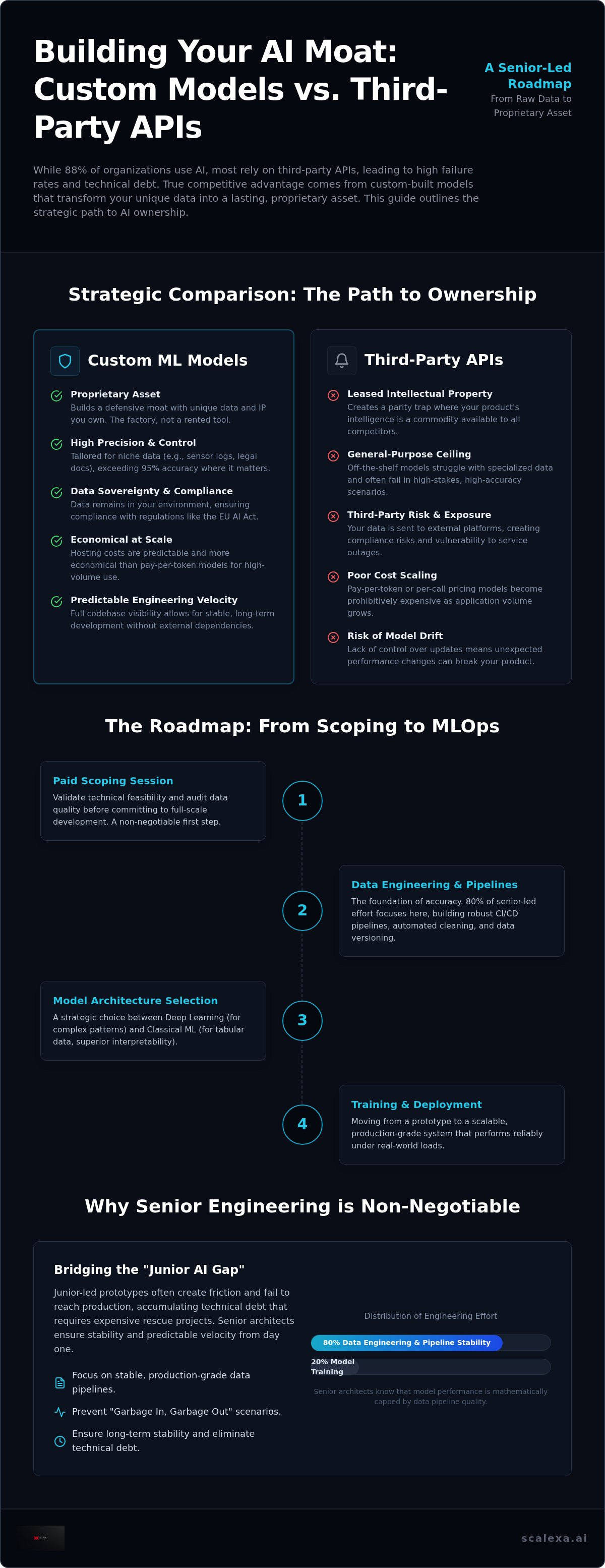
The Roadmap: From Scoping to MLOps
Moving from a localized prototype to a production-grade intelligence system is where most AI initiatives fail. Successful custom machine learning model development requires a methodical transition from initial validation to long-term operations. This roadmap ensures that engineering effort translates into measurable business outcomes rather than becoming an expensive research project. The Scoping Session is the primary tool for de-risking AI investment by ensuring technical feasibility before capital is committed. By following a structured lifecycle, you maintain predictable engineering velocity and avoid the common pitfalls of junior-led experimentation.
The Scoping Phase: Defining Technical Feasibility
We mandate a paid scoping session for every engagement to align technical architecture with high-level business goals. This phase focuses on assessing data availability and quality. We determine if you have enough signal within your datasets to actually train a model that meets your performance requirements. Instead of attempting a "moonshot" project, we define a Minimum Viable Model (MVM). This MVM allows you to prove ROI early and validate the core logic before scaling the system. It's a transparent process that identifies technical blockers before they become costly delays. If the data isn't ready, we tell you immediately rather than billing for unproductive development hours.
Ready to validate your AI roadmap? Book a paid scoping session with our senior architects to audit your data and define your path to production.
MLOps: Ensuring Long-Term Model Reliability
Model deployment is not the finish line; it's the start of the MLOps lifecycle. Production environments are dynamic, and models naturally decay as real-world data evolves. We build automated retraining loops to prevent this performance degradation, ensuring your system remains accurate over time. Our senior engineers utilize cloud-native scaling on platforms like AWS, Azure, or GCP, often leveraging Kubernetes to manage containerized workloads efficiently. This infrastructure allows your model to handle variable traffic without manual intervention. We also implement continuous monitoring for two critical factors:
- Data Drift: Detecting when the input data significantly changes from the training set.
- Model Bias: Ensuring the system remains fair and compliant with 2026 regulatory standards like the Colorado Artificial Intelligence Act.
- Latency Performance: Maintaining high-velocity response times as user volume scales.
This systematic precision transforms your AI from a static tool into a living, reliable component of your enterprise stack. By prioritizing pipeline stability and automated monitoring, we ensure your proprietary intelligence remains a stable asset for years to come.
Why Senior Engineering is Non-Negotiable for AI Success
Prompt engineering is not engineering. It's a surface-level interaction with a model someone else built. True custom machine learning model development requires a deep understanding of data structures, loss functions, and infrastructure scaling. The "Junior AI Gap" represents the distance between a prototype that works on a laptop and a system that scales to millions of users without crashing. When inexperienced teams lead these projects, the result is often a "rescue project" that costs twice as much to fix as it would have cost to build correctly the first time. Senior architects build faster because they've already seen the pitfalls that stall junior developers for weeks.
Scalexa eliminates this friction by operating a senior-engineers-only model. We don't staff your project with juniors who need on-the-job training. Our collective 30+ years of experience ensures that architectural decisions are made with the end goal of production stability in mind. This expertise allows us to maintain a predictable engineering velocity, moving from complex technical challenges to functional code with systematic precision. We prioritize results over promises, ensuring your AI initiatives move from experimental stages to production-grade intelligence without the usual chaotic effort.
Predictability Over Heroics
We reject the chaotic "heroics" often found in software development. Instead, we use a transparent weekly billing model based on actual hours worked. This approach provides total visibility into our progress and allows for the flexibility required in high-velocity AI environments. Senior engineers manage technical debt as they build, ensuring that the platform remains scalable rather than becoming a brittle legacy system. Our role often functions as a Fractional CTO, aligning technical execution with your executive strategy to ensure every engineering hour contributes to the bottom line. This methodical approach ensures that complex challenges are handled with the calm authority your project deserves.
Partnering for High-Velocity Output
We don't view ourselves as a vendor. We are a seamless extension of your team, operating at the standards required by Fortune 500 firms and high-growth startups alike. This integrated partnership ensures that we aren't just delivering code; we're building a proprietary business asset that creates a long-term moat. By focusing on repeatable processes and logical systems, we remove the uncertainty from AI development. Our goal is to move quickly from one concept to the next without unnecessary transitions, mirroring the iterative nature of modern technical workflows. If you're tired of prototypes that never reach production, it's time to switch to a senior-led approach. Ready to build proprietary intelligence? Start with a Scoping Session.
Securing Your Proprietary Moat
Owning your AI infrastructure is the only way to escape the parity trap of commodity APIs. Custom machine learning model development transforms your unique data into a defensive business asset that competitors cannot replicate. By prioritizing pipeline stability over experimental heroics, you ensure your intelligence scales with your growth. This strategic shift from renting tools to owning the factory is what separates industry leaders from those merely following the hype.
Scalexa provides the senior-led precision required to move from raw data to production-grade results. Our senior-engineers-only model brings Fortune 500 and high-growth startup experience directly to your mission. We operate with transparent weekly billing, ensuring you always have a clear view of your project's velocity and technical health without the hidden costs of junior-led technical debt. We focus on high-velocity output and systematic precision to ensure your success.
Don't let your AI strategy stall at the prototype stage. Book a Paid Scoping Session to De-Risk Your AI Project and build the foundation for your long-term competitive advantage. Your data is ready to work; it's time to build the system that unlocks its true value.
Frequently Asked Questions
Is it feasible to create a custom machine learning model for a small business?
Custom models are feasible for small businesses when they solve a specific, high-value problem that off-the-shelf tools cannot address. We require a minimum project size of $5,000 to ensure we deliver a production-grade asset rather than a brittle prototype. The key is identifying a niche use case where proprietary intelligence creates a competitive moat. Our paid scoping session determines if your data volume supports a model that provides actual business value.
How much does custom machine learning model development cost?
We operate on a transparent weekly billing model based on actual hours worked by senior engineers. This approach provides flexibility and avoids the risks associated with fixed-price project bidding. Total investment depends on data complexity and the specific architecture required for your mission. By starting with a mandatory scoping session, we provide a clear technical roadmap and budget estimate before long-term development begins to prevent wasted capital and ensure technical feasibility.
What is the difference between a custom ML model and an API like GPT-4?
APIs like GPT-4 are general-purpose tools that you lease from a third party. They introduce risks like model drift, privacy concerns, and sudden service outages. Custom machine learning model development allows you to own the intellectual property and host the model within your own infrastructure. This ensures your data stays private and your system remains stable even if a third-party provider changes their pricing or underlying model architecture.
How long does it take to develop a custom machine learning model?
Development timelines depend on your data readiness and the complexity of your business logic. A production-ready system typically takes several months to move from initial architecture to a stable MLOps lifecycle. We prioritize high-velocity output through senior-led engineering, avoiding the delays common in junior-heavy teams. Our weekly delivery model ensures you see incremental progress and functional code throughout the entire development process rather than waiting for a final reveal.
What data do I need to start custom ML development?
You need structured or unstructured data that contains a clear signal for the task you want to automate. This could include proprietary sensor logs, customer transaction history, or specialized text documents unique to your industry. The volume of data required depends on the complexity of the model architecture. During our initial scoping phase, we audit your existing datasets to verify if they have the quality and quantity necessary to train a reliable model.
Can a custom model be integrated with my existing cloud infrastructure?
Yes, we build models specifically to integrate with your existing cloud infrastructure on AWS, Azure, or GCP. Our senior engineers utilize containerization and Kubernetes to ensure the model scales seamlessly within your current DevOps environment. This approach maintains data sovereignty and allows your internal team to manage the infrastructure after deployment. We focus on building a seamless extension of your current technical stack rather than a disconnected silo.
How do I know if my project needs a custom model or just fine-tuning?
Fine-tuning is the logical choice when you can adapt an existing open-source model to your specific domain terminology. It provides a high-performance middle ground for many natural language tasks. You require full custom machine learning model development when your use case involves unique data types or proprietary business logic that pre-trained models cannot handle. We use our initial scoping phase to identify the most cost-effective path for your specific technical requirements.
What is the failure rate of custom ML projects and how do I avoid it?
Many AI projects fail due to poor data quality, lack of technical feasibility, or junior-led architectural mistakes. You avoid these risks by starting with a paid scoping session to validate the project before writing a single line of code. Our senior-engineers-only model ensures that your architecture is built for production from day one. We use systematic precision and transparent weekly reporting to keep the project aligned with your executive strategy and business goals.
Frequently Asked Questions
Custom models are feasible for small businesses when they solve a specific, high-value problem that off-the-shelf tools cannot address. We require a minimum project size of $5,000 to ensure we deliver a production-grade asset rather than a brittle prototype. The key is identifying a niche use case where proprietary intelligence creates a competitive moat. Our paid scoping session determines if your data volume supports a model that provides actual business value.
We operate on a transparent weekly billing model based on actual hours worked by senior engineers. This approach provides flexibility and avoids the risks associated with fixed-price project bidding. Total investment depends on data complexity and the specific architecture required for your mission. By starting with a mandatory scoping session, we provide a clear technical roadmap and budget estimate before long-term development begins to prevent wasted capital and ensure technical feasibility.
APIs like GPT-4 are general-purpose tools that you lease from a third party. They introduce risks like model drift, privacy concerns, and sudden service outages. Custom machine learning model development allows you to own the intellectual property and host the model within your own infrastructure. This ensures your data stays private and your system remains stable even if a third-party provider changes their pricing or underlying model architecture.
Development timelines depend on your data readiness and the complexity of your business logic. A production-ready system typically takes several months to move from initial architecture to a stable MLOps lifecycle. We prioritize high-velocity output through senior-led engineering, avoiding the delays common in junior-heavy teams. Our weekly delivery model ensures you see incremental progress and functional code throughout the entire development process rather than waiting for a final reveal.
You need structured or unstructured data that contains a clear signal for the task you want to automate. This could include proprietary sensor logs, customer transaction history, or specialized text documents unique to your industry. The volume of data required depends on the complexity of the model architecture. During our initial scoping phase, we audit your existing datasets to verify if they have the quality and quantity necessary to train a reliable model.
Yes, we build models specifically to integrate with your existing cloud infrastructure on AWS, Azure, or GCP. Our senior engineers utilize containerization and Kubernetes to ensure the model scales seamlessly within your current DevOps environment. This approach maintains data sovereignty and allows your internal team to manage the infrastructure after deployment. We focus on building a seamless extension of your current technical stack rather than a disconnected silo.
Fine-tuning is the logical choice when you can adapt an existing open-source model to your specific domain terminology. It provides a high-performance middle ground for many natural language tasks. You require full custom machine learning model development when your use case involves unique data types or proprietary business logic that pre-trained models cannot handle. We use our initial scoping phase to identify the most cost-effective path for your specific technical requirements.
Many AI projects fail due to poor data quality, lack of technical feasibility, or junior-led architectural mistakes. You avoid these risks by starting with a paid scoping session to validate the project before writing a single line of code. Our senior-engineers-only model ensures that your architecture is built for production from day one. We use systematic precision and transparent weekly reporting to keep the project aligned with your executive strategy and business goals.