'%20fill='%23000000'%20stroke='none'%3e%3cpath%20d='M%201784.53%205631.9%20C%201775.53%205618.9%201692.53%205479.9%201598.53%205322.9%20C%201395.53%204983.9%201355.53%204919.9%201342.53%204915.9%20C%201332.53%204912.9%201315.53%204938.9%201090.53%205311.9%20C%201023.53%205423.9%20960.53%205523.9%20951.53%205534.9%20C%20936.53%205549.9%20918.53%205552.9%20816.53%205552.9%20C%20751.53%205552.9%20696.53%205548.9%20692.53%205542.9%20C%20689.53%205537.9%20721.53%205475.9%20763.53%205405.9%20C%20806.53%205335.9%20855.53%205252.9%20872.53%205222.9%20C%20889.53%205192.9%20941.53%205106.9%20987.53%205032.9%20C%201032.53%204958.9%201161.53%204746.9%201272.53%204562.9%20C%201383.53%204378.9%201522.53%204147.9%201581.53%204050.9%20L%201689.53%203872.9%20L%201823.53%203872.9%20C%201897.53%203872.9%201957.53%203874.9%201957.53%203876.9%20C%201957.53%203879.9%201887.53%203997.9%201800.53%204139.9%20C%201513.53%204612.9%201487.53%204657.9%201487.53%204674.9%20C%201487.53%204697.9%201788.53%205192.9%201802.53%205192.9%20C%201807.53%205192.9%201830.53%205162.9%201852.53%205125.9%20C%201874.53%205088.9%201902.53%205042.9%201913.53%205023.9%20C%201925.53%205003.9%201993.53%204890.9%202065.53%204772.9%20C%202395.53%204228.9%202458.53%204121.9%202452.53%204112.9%20C%202448.53%204106.9%202382.53%204102.9%202287.53%204102.9%20C%202200.53%204102.9%202126.53%204098.9%202123.53%204094.9%20C%202120.53%204089.9%202147.53%204038.9%202183.53%203979.9%20L%202249.53%203872.9%20L%202563.53%203872.9%20C%202736.53%203872.9%202877.53%203875.9%202877.53%203878.9%20C%202877.53%203882.9%202812.53%203991.9%202734.53%204121.9%20C%202537.53%204445.9%202057.53%205239.9%201929.53%205452.9%20C%201801.53%205664.9%201804.53%205662.9%201784.53%205631.9%20Z'%20style='fill:%20rgb(215,%2032,%2038);'/%3e%3cpath%20d='M%202191.53%205539.9%20C%202187.53%205527.9%202443.53%205099.9%203052.53%204100.9%20L%203191.53%203872.9%20L%203324.53%203872.9%20C%203397.53%203872.9%203457.53%203874.9%203457.53%203876.9%20C%203457.53%203879.9%203366.53%204031.9%203255.53%204214.9%20C%203144.53%204397.9%202964.53%204696.9%202854.53%204877.9%20C%202744.53%205059.9%202607.53%205285.9%202550.53%205380.9%20L%202445.53%205552.9%20L%202321.53%205552.9%20C%202226.53%205552.9%202195.53%205549.9%202191.53%205539.9%20Z'%20style='fill:%20rgb(215,%2032,%2038);'/%3e%3cpath%20d='M%201029.53%204386.9%20C%201014.53%204360.9%20993.53%204325.9%20982.53%204308.9%20C%20970.53%204291.9%20938.53%204237.9%20909.53%204187.9%20C%20880.53%204138.9%20829.53%204053.9%20797.53%203999.9%20C%20764.53%203944.9%20737.53%203894.9%20737.53%203886.9%20C%20737.53%203874.9%20759.53%203872.9%20864.53%203874.9%20L%20991.53%203877.9%20L%201099.53%204049.9%20L%201207.53%204220.9%20L%201144.53%204326.9%20C%201110.53%204384.9%201076.53%204432.9%201069.53%204432.9%20C%201062.53%204432.9%201044.53%204411.9%201029.53%204386.9%20Z'%20style='fill:%20rgb(215,%2032,%2038);'/%3e%3c/g%3e%3c/svg%3e)

Custom LLM Development for Business: Building Proprietary Intelligence in 2026
Most companies are still renting their intelligence from public providers, effectively building their core value on infrastructure they don't own. By 2026, relying solely on generic APIs is a technical debt trap. You've likely realized that custom llm development for business is no longer optional if you want to protect your margins. Generic models fail on your domain-specific terminology. Rising per-token costs make your unit economics unsustainable. Data privacy remains a constant anxiety when every prompt feeds a third-party model.
We agree that the time for simple wrappers has passed. It's time for execution. This article explains how to build secure, high-performance models that offer predictable infrastructure costs and full control over model behavior. This shift transforms AI from a monthly subscription expense into a defensible asset. We'll explore the engineering required to build a proprietary system that truly belongs to your enterprise, ensuring your competitive advantage is built on code, not just prompts.
Key Takeaways
- Move beyond generic AI wrappers to build proprietary intelligence assets that you own and control.
- Discover how custom llm development for business integrates RAG and fine-tuning to solve for domain-specific accuracy and data privacy.
- Navigate the transition from a proof-of-concept to a production-ready system capable of handling enterprise-scale request volumes.
- Secure your data sovereignty by choosing the right infrastructure, whether on-premise, VPC, or managed AI clouds.
- Use a mandatory scoping phase to validate technical feasibility and ensure your AI project delivers measurable business value.
Beyond the API: What Custom LLM Development Means for Business
In 2026, the distinction between using AI and owning AI defines market leaders. Custom llm development for business has evolved from a luxury experiment into a core engineering requirement. While a generic Large Language Model (LLM) provides broad utility, it lacks the surgical precision required for high-stakes enterprise operations. Real value lies in moving away from rented intelligence and toward proprietary assets that capture your company's unique logic and data.
This shift represents a transition from simple prompt engineering to robust platform engineering. You aren't just asking a model to perform a task; you're building a system where the model is deeply integrated into your data stack. Ownership means you control the weights, the training data, and the deployment environment. This level of control is the only way to ensure that your AI initiatives drive long-term enterprise value rather than temporary efficiency gains.
The Problem with Public AI Wrappers
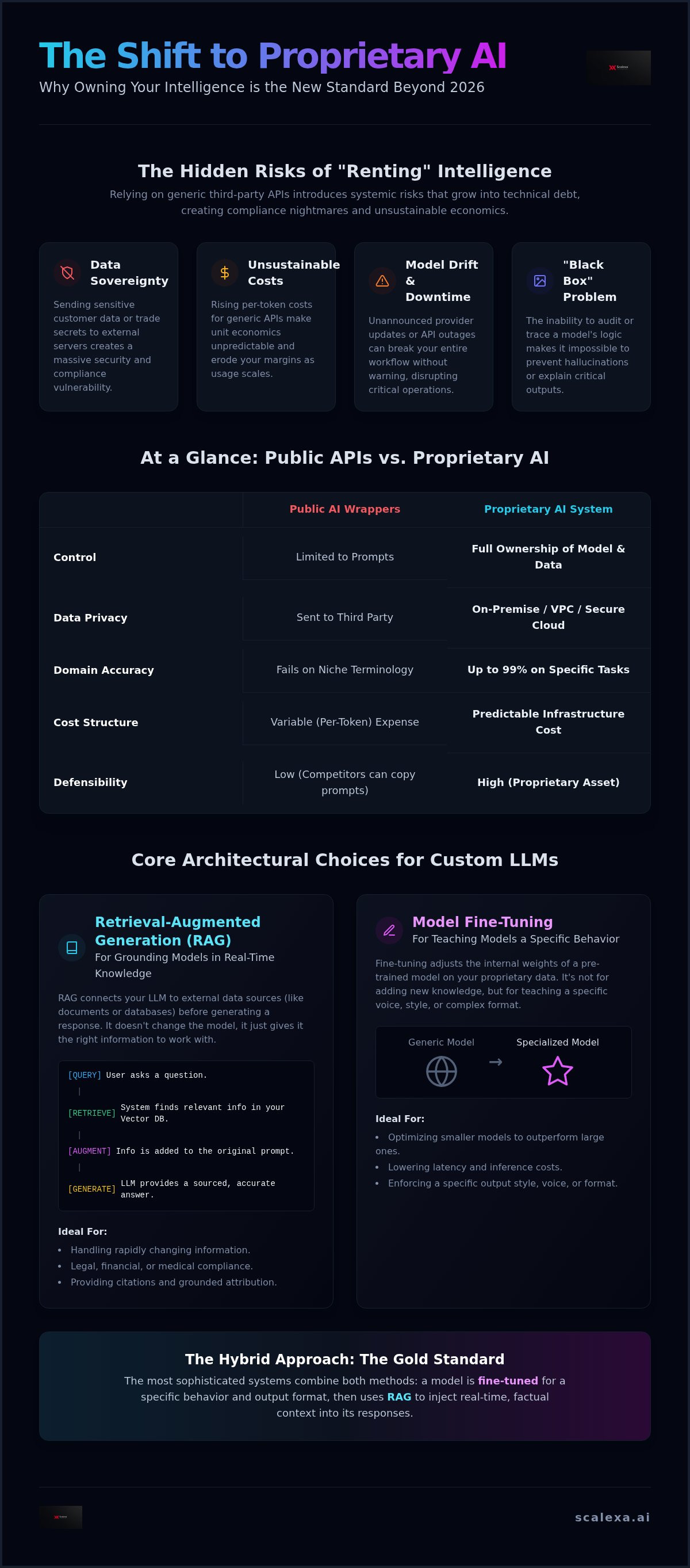
Relying on third-party APIs introduces systemic risks that many executives overlook until a failure occurs. Data sovereignty is the primary concern. Sending sensitive customer data or trade secrets to a public provider's server creates a compliance nightmare and a security vulnerability. Reliability is another friction point. When a public model experiences downtime or "model drift" through unannounced updates, your entire workflow breaks without warning. Finally, the black box nature of public models makes auditing impossible. If a model provides a hallucinated legal or financial recommendation, you have no way to trace the logic or prevent it from happening again.
The Proprietary Intelligence Advantage
Custom llm development for business allows you to build a defensible moat that competitors cannot copy with a better prompt. By training on your proprietary datasets, you achieve accuracy levels that general models can't match. We've seen specialized models reach 99% accuracy on industry-specific terminology where generic alternatives fail. Proprietary Intelligence is the integration of specialized data and custom-tuned architecture into a private, high-performance asset that your competitors cannot replicate. This control ensures that your AI remains stable, secure, and perfectly aligned with your operational goals. It transforms a variable cost into a permanent, scalable asset.
Architectural Choices: Fine-Tuning, RAG, and Training from Scratch
Choosing an architecture is the most consequential decision in custom llm development for business. It dictates your long-term infrastructure costs, response accuracy, and system latency. Most enterprises shouldn't start by training a model from scratch. Instead, the focus is on how to effectively bridge the gap between a foundation model and your proprietary data through retrieval and weight optimization.
When to Use Retrieval-Augmented Generation (RAG)
RAG is the operational standard for 2026. It allows your model to consult external documents before generating a response. This approach is ideal for handling rapidly changing data because you don't need to re-train the model every time a document or database record updates.
- Vector database selection: Choosing between Pinecone, Milvus, or Weaviate depends on your scale. Pinecone offers a managed experience, while Milvus and Weaviate provide more control for on-premise or VPC deployments.
- Grounded attribution: RAG allows the system to cite sources, which is mandatory for legal, financial, and medical compliance where accuracy is non-negotiable.
The Strategic Case for Fine-Tuning
The choice between RAG and fine-tuning is central to custom llm development for business. Fine-tuning involves adjusting the actual weights of the model. You don't do this to give the model new knowledge; you do it to teach the model a specific behavior, voice, or complex formatting style.
- Model specialization: Optimizing smaller, open-source models like Llama 4 or Mistral often outperforms larger, generic models on niche tasks while reducing latency.
- Cost efficiency: Specialized models use fewer tokens to achieve the same result, which directly lowers your monthly inference spend.
The most sophisticated systems use a hybrid architecture. They fine-tune a model for a specific output format and then use RAG to provide real-time context. This dual approach maximizes performance while keeping infrastructure predictable. If you're unsure which path fits your specific data stack, a paid scoping session can define the technical roadmap before you commit to development. This ensures technical feasibility before the first line of code is written.
Training a foundation model from scratch is rarely the right ROI for most businesses in 2026. It requires massive compute resources and vast datasets that few companies possess. Unless you're building a new industry standard or have extreme privacy requirements that preclude any third-party foundation, stick to the hybrid RAG and fine-tuning model. It delivers high-velocity results and 95% of the performance at a fraction of the capital expenditure.
The Engineering Reality: Why AI Wrappers Fail at Enterprise Scale
A successful prototype isn't a successful product. In the current market, roughly 80% of AI projects fail to reach production because they're built as thin wrappers around third-party APIs. These wrappers lack the architectural depth required to handle enterprise demands. When you transition from a single-user demo to a high-concurrency environment, generic solutions crumble under the weight of latency, cost, and reliability issues. True custom llm development for business requires an engineering-first mindset that prioritizes long-term stability over quick demos.
Managing high-concurrency AI requests is a significant infrastructure challenge. You aren't just scaling a database; you're managing GPU availability, request queuing, and model load balancing. Junior-heavy teams often overlook these complexities, leading to technical debt that requires a complete rebuild within months. Senior-led engineering ensures that the system is designed for scale from day one, treating AI as a mission-critical component rather than a bolted-on feature. This prevents the "Proof of Concept" trap where projects look impressive in testing but fail under real-world load.
Inference Optimization and Tokenomics
Inefficient token usage is a silent profit killer. Without optimization, your monthly compute bill scales linearly with your user base, destroying your unit economics. We implement quantization techniques to reduce model size, allowing high-performance models to run on more affordable hardware without significant accuracy loss. Caching layers are equally vital; they prevent the system from re-computing identical requests, which slashes latency for frequent queries. Industry data indicates that senior architects can reduce long-term compute costs by up to 40% through these optimization strategies.
Handling Non-Deterministic Outputs
Large language models are inherently unpredictable. This non-deterministic nature is the enemy of enterprise reliability. To move beyond the prototype phase, you need robust evaluation frameworks that test model outputs against thousands of edge cases before deployment. Simple keyword filters aren't enough for 2026 standards. You need sophisticated guardrails and safety layers that monitor intent and context in real-time. We treat models like code, using version control for weights and prompts to ensure that every update is measurable and reversible. This systematic approach to custom llm development for business transforms a "black box" into a predictable, auditable enterprise asset.
Strategic Implementation: From Data Sovereignty to Production-Ready MLOps
Engineering the model is only a fraction of the work. Data engineering represents roughly 80% of the effort in custom llm development for business. Without a clean, structured, and secure data pipeline, even the most advanced architecture will produce unreliable results. Success in 2026 requires moving beyond the "experimental" phase and building a production-ready environment that treats AI as a core component of your software stack.
Your choice of infrastructure dictates your level of data sovereignty. On-premise deployments provide the highest level of security but require significant capital expenditure. Virtual Private Clouds (VPC) offer a balanced middle ground, providing isolated environments within public cloud providers. Managed AI clouds are the fastest to deploy but often come with trade-offs in long-term cost and data control. We help you evaluate these options based on your regulatory requirements and scaling needs.
Data Sanitization and Preparation
High-quality outputs require high-quality inputs. Data sanitization is the process of removing Personally Identifiable Information (PII) and sensitive metadata before any training or retrieval occurs. This step is mandatory for maintaining GDPR and SOC2 compliance. Once sanitized, unstructured data must be partitioned and indexed for efficient RAG retrieval. We also emphasize "human-in-the-loop" labeling for edge cases. Expert human feedback ensures the model understands nuances that automated systems might miss, particularly in specialized industries like fintech or healthcare.
MLOps: The Backbone of Production AI
Moving from a proof-of-concept to a production environment requires a robust MLOps pipeline. This is essentially CI/CD for machine learning. It includes automated triggers that retrain the model when performance metrics dip or new data becomes available. Scaling these systems requires GPU-optimized Kubernetes clusters to manage inference loads effectively. Security is not an afterthought; it is integrated into the infrastructure through continuous monitoring and encrypted data transit. This systematic approach ensures your AI remains stable, secure, and performant under heavy enterprise usage.
Building a proprietary intelligence system is a high-stakes investment. To ensure your project is technically feasible and strategically aligned, you should book a paid scoping session with our senior engineering team. We'll audit your data readiness and define a clear roadmap for your custom implementation, removing the guesswork from your AI strategy.
Continuous monitoring is the final piece of the puzzle. Models aren't static; they experience "drift" as real-world data evolves. We implement real-time tracking to monitor latency, accuracy, and token efficiency. If the model’s performance deviates from established benchmarks, the MLOps pipeline alerts the team or triggers a corrective retraining cycle. This level of oversight is what separates a fragile AI wrapper from a resilient enterprise asset.
Scalexa’s Approach: High-Velocity LLM Engineering with Senior Talent
High-stakes AI development is an engineering discipline that leaves no room for junior-level experimentation. At Scalexa, we've built our model on a senior-only engineering foundation. This ensures that every line of code contributes to a stable, production-ready system. Our approach to custom llm development for business centers on eliminating the trial-and-error phase common in junior-led projects. We position ourselves as an elite specialist partner, functioning as a seamless extension of your technical team. This provides the fractional CTO leadership needed to navigate complex AI roadmaps without the overhead of managing inexperienced developers.
The Scalexa Scoping Framework
Every engagement begins with a mandatory paid scoping session. We evaluate your data readiness to determine if your proprietary information can support your use case. During this phase, we design the specific architecture mix of models and infrastructure required for your goals. This process de-risks your investment by providing senior-led estimations for timelines and budget. It's the only way to ensure technical feasibility before writing the first line of code.
Why Weekly Billing Wins for AI
Traditional fixed-price bidding is incompatible with the iterative nature of AI. Model performance data often reveals new optimization paths mid-project. Our weekly billing system provides the flexibility to pivot without the friction of formal change orders. You pay for actual senior engineering hours, ensuring full transparency with no hidden margins. This high-velocity model allows us to focus entirely on output and performance metrics rather than administrative contract hurdles.
By removing the overhead of junior management and fixed-bid constraints, we deliver high-performance proprietary intelligence with systematic precision. Our minimum project size of $5,000 ensures we focus on high-impact solutions that drive real enterprise value. We don't just build models; we deliver custom llm development for business that integrates directly into your existing DevOps and cloud infrastructure. This results in a predictable, scalable AI system that belongs entirely to your business. You gain a competitive advantage that generic wrappers can't match, backed by a team that prioritizes technical excellence over marketing promises.
Securing Your Defensible AI Advantage
The transition from renting generic AI to owning proprietary intelligence is the defining technical shift of 2026. Companies that move beyond basic wrappers will secure a defensible advantage through data sovereignty and predictable unit economics. Successful custom llm development for business requires more than just prompt engineering; it demands a robust MLOps foundation and senior-level architectural precision.
Scalexa provides this precision through our senior-engineers-only model and 30+ years of collective experience. We eliminate the friction of traditional contracts with transparent weekly billing and start every engagement with a mandatory technical audit. Stop building on infrastructure you don't own.
Book a Paid Scoping Session to Architect Your Proprietary AI and take full control of your enterprise intelligence. Building a proprietary model is a significant technical investment. It's time to execute with a partner who prioritizes results over promises.
Frequently Asked Questions
How much does custom LLM development cost for a business?
Costs for custom llm development for business vary based on architectural complexity and data readiness. At Scalexa, we operate on a transparent weekly billing model based on actual hours worked by senior engineers. Our minimum project size starts at $5,000. This approach ensures you pay for high-velocity output rather than padded fixed-bid estimates. The total investment depends on whether you require a simple RAG implementation or complex model fine-tuning.
What is the difference between RAG and fine-tuning?
Retrieval-Augmented Generation (RAG) allows a model to consult external databases before generating a response, which is ideal for real-time data. Fine-tuning involves adjusting the internal weights of the model to master a specific voice or formatting style. While RAG provides the context, fine-tuning provides the behavior. Most enterprise-grade solutions in 2026 use a hybrid architecture that combines both methods to achieve maximum accuracy and performance.
How long does it take to build a production-ready custom LLM?
A production-ready system typically requires three to six months for full deployment. This timeline includes data engineering, architecture selection, and the implementation of robust MLOps pipelines. We begin every engagement with a mandatory paid scoping session to define the exact technical roadmap and timeline. This phase eliminates guesswork and ensures your budget aligns with the engineering reality of your specific use case before long-term development starts.
Can we run a custom LLM on our own servers for security?
Yes, you can deploy custom models on-premise or within a Virtual Private Cloud (VPC) to maintain full data sovereignty. This setup is often mandatory for companies in regulated industries like healthcare or finance. By running models on your own infrastructure, you eliminate the risk of sensitive data leaking to third-party providers. We handle the DevOps and cloud infrastructure requirements to ensure your private environment is optimized for high-concurrency AI requests.
Do we need a massive dataset to build a custom model?
You don't need massive datasets if you focus on data quality. High-quality, domain-specific information is far more valuable than millions of generic records. For most companies, custom llm development for business succeeds by using a few thousand well-labeled examples to fine-tune behavior or a structured knowledge base for RAG. We audit your existing data during the scoping phase to determine if it's sufficient to support your specific business objectives.
How do we prevent a custom LLM from hallucinating?
Hallucinations are mitigated through a combination of RAG and strict evaluation frameworks. By grounding the model in verified source documents, the system provides citations rather than inventing facts. We also implement sophisticated guardrails and safety layers that monitor model outputs in real-time. Senior-led engineering is critical here; we build systematic testing environments that identify and correct non-deterministic errors before they reach your end users or production environment.
What is the ROI of custom LLM development vs. using OpenAI?
The ROI of custom development comes from reduced token costs and the creation of a defensible intelligence asset. While public APIs like OpenAI are easy to start with, they become expensive at scale and offer no competitive moat. A custom model provides predictable infrastructure costs and 99% accuracy on industry-specific terminology. Ownership means you aren't vulnerable to third-party price hikes or unannounced model updates that could break your core business processes.
Is a paid scoping session necessary for AI development?
At Scalexa, a paid scoping session is mandatory for all new AI engagements. This initial phase allows our senior team to conduct technical feasibility studies and design a custom architecture tailored to your data stack. It de-risks your investment by identifying potential blockers before you commit to a full development cycle. You receive a clear roadmap, budget estimate, and architectural design, ensuring the project starts with a logical, systematic plan.
Frequently Asked Questions
Costs for custom llm development for business vary based on architectural complexity and data readiness. At Scalexa, we operate on a transparent weekly billing model based on actual hours worked by senior engineers. Our minimum project size starts at $5,000. This approach ensures you pay for high-velocity output rather than padded fixed-bid estimates. The total investment depends on whether you require a simple RAG implementation or complex model fine-tuning.
Retrieval-Augmented Generation (RAG) allows a model to consult external databases before generating a response, which is ideal for real-time data. Fine-tuning involves adjusting the internal weights of the model to master a specific voice or formatting style. While RAG provides the context, fine-tuning provides the behavior. Most enterprise-grade solutions in 2026 use a hybrid architecture that combines both methods to achieve maximum accuracy and performance.
A production-ready system typically requires three to six months for full deployment. This timeline includes data engineering, architecture selection, and the implementation of robust MLOps pipelines. We begin every engagement with a mandatory paid scoping session to define the exact technical roadmap and timeline. This phase eliminates guesswork and ensures your budget aligns with the engineering reality of your specific use case before long-term development starts.
Yes, you can deploy custom models on-premise or within a Virtual Private Cloud (VPC) to maintain full data sovereignty. This setup is often mandatory for companies in regulated industries like healthcare or finance. By running models on your own infrastructure, you eliminate the risk of sensitive data leaking to third-party providers. We handle the DevOps and cloud infrastructure requirements to ensure your private environment is optimized for high-concurrency AI requests.
You don't need massive datasets if you focus on data quality. High-quality, domain-specific information is far more valuable than millions of generic records. For most companies, custom llm development for business succeeds by using a few thousand well-labeled examples to fine-tune behavior or a structured knowledge base for RAG. We audit your existing data during the scoping phase to determine if it's sufficient to support your specific business objectives.
Hallucinations are mitigated through a combination of RAG and strict evaluation frameworks. By grounding the model in verified source documents, the system provides citations rather than inventing facts. We also implement sophisticated guardrails and safety layers that monitor model outputs in real-time. Senior-led engineering is critical here; we build systematic testing environments that identify and correct non-deterministic errors before they reach your end users or production environment.
The ROI of custom development comes from reduced token costs and the creation of a defensible intelligence asset. While public APIs like OpenAI are easy to start with, they become expensive at scale and offer no competitive moat. A custom model provides predictable infrastructure costs and 99% accuracy on industry-specific terminology. Ownership means you aren't vulnerable to third-party price hikes or unannounced model updates that could break your core business processes.
At Scalexa, a paid scoping session is mandatory for all new AI engagements. This initial phase allows our senior team to conduct technical feasibility studies and design a custom architecture tailored to your data stack. It de-risks your investment by identifying potential blockers before you commit to a full development cycle. You receive a clear roadmap, budget estimate, and architectural design, ensuring the project starts with a logical, systematic plan.